Friday, December 21, 2018

Wow, what a week! And now we're almost half way through the year. I can't believe it. We had a fun week.


In math we took a little break from adding/subtracting and we worked on writing songs that could help us remember how to skip count every number from 1-10.  Everyone felt comfortable with 1, 2, 5, and 10, so we broke into groups and focused on the remainder: 4, 6, 7, 8, 9. For the number 3, I shared an old song from my childhood: 3 is a Magic Number from Schoolhouse Rocks! The kids loved it, easily memorized it, and were excited to try and write their own songs. Here's the one I shared:


We came up with a grading rubric to decide how to assess this project, so everyone is on board and knows what they're doing and why.

In social, Mrs. Wilson gave the students a test on their knowledge of Peru. The tests were returned. Ask your student how they did.

In science we had a great time. We created a dichotomous key (a fancy word for a way of sorting objects) on our tables. We used these to sort a collection of rocks. The students had to decide what properties they wanted to use to break the rocks into different groups.


We also somehow managed to squeeze in a crystal-making session. We then examined them under microscopes and got some really cool views of their formations up close. 


We ended the week watching The Secret of NIMH, based on the book we read this term as a class. Next, we'll be doing a project on this, comparing and contrasting different scenes from the movie with the book and discussing why these differences might exist. 


Well, that's it for now. Have a fantastic holiday with your families and friends. Rest, enjoy, and have some fun. See you soon!

Saturday, December 15, 2018

Hello everyone.

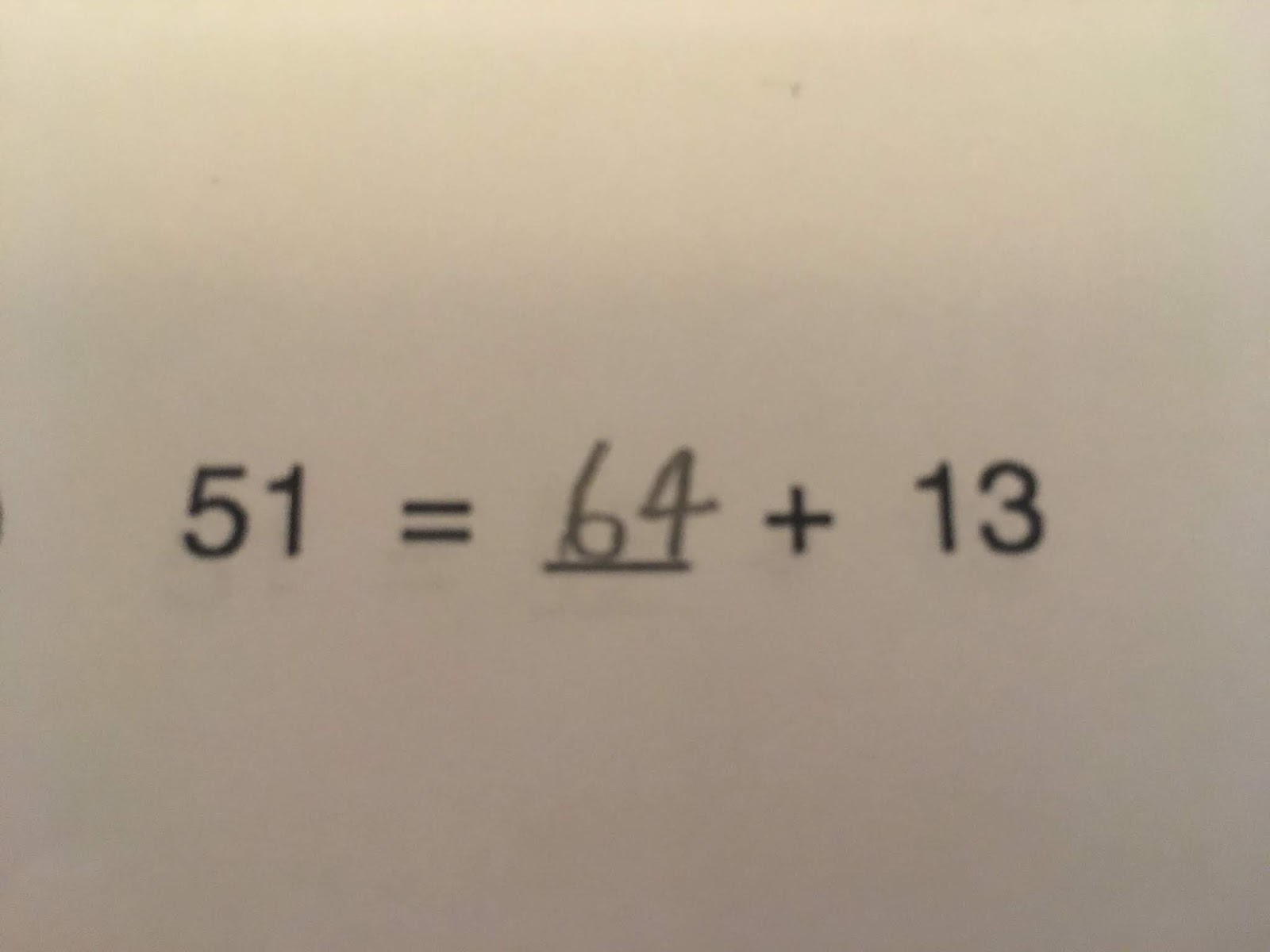
This week I revisited a topic we had discussed on several occasions. We looked at the = sign. We discussed how it is not simply a symbol that tells us where the answer goes, but rather is more like a balance. I used a teeter-totter analogy.

Revisiting concepts is important in math. Too often a topic is covered, and then we simply move on. I wrote on the board:

I took a poll for the answer, and it was overwhelmingly 12. I asked what happened to the 3? That was the lead-in to our conversation. We looked at several more simpler examples, talked. Did more challenges. Talked. Eventually we worked up to more challenging questions.

The children really enjoyed the challenges. We'll step back a bit, combine these ideas into word problems and make sure we're really understanding the questions. These algebraic/equation-balancing questions were a lot of fun, and some of the kids saw that we had already been doing them in our word problems. They were excited to see the links and relationships.

In science we continued with our examination of rocks and minerals by exploring the difference between the two. We did an activity where I gave them a variety of descriptions (contains fossils, has a crystalline form) and they had to make an educated guess about whether it was a feature of a rock or a mineral. They did this in small groups, sharing their background knowledge and making inferences and guesses. We then came back together and figured it out together. Once we had our information correctly assembled, we created a chart that we can use as we go forward in our work.

This coming week we will take a large group of rock samples and begin looking at how we could categorize them. We'll build a dichotomous tree, like the following image.

This taxonomic activity will let the kids handle and closely examine a large number of rocks and get them thinking about how scientists do this type of work, what characteristics they could be looking for, and how they can do it with their own background knowledge and observation skills.

I also asked for them to start bringing in glass jars. I hope to make crystals. It is unlikely to happen this coming week, but if you have any extra jam, pickle, etc. jars, please send them in.

In literacy we worked together with Mrs. Wilson's class on a writing prompt of a Norman Rockwell painting.

We discussed what we thought was going on in the picture. We then had to write a short story, using descriptive language, similes, metaphors. Our goal was to create an interesting story that hooked our reader.

In social studies, your children should have brought home a study guide this week for a test on Peru on Monday with Mrs. Wilson. Please help them to study for this test.

Friday, December 7, 2018

Hello again.
In math we held off on starting the pet budget project as our addition and subtraction skills needed a bit more of a focus. We should start it next week. We also continued to work on word problems, adding complexity in the wording if not the actual required operations. We really dug in and broke down the questions to find out what they were truly asking. This is an important skill, but it also speaks to number sense. As students develop their number sense, many word problems will resolve themselves as the students begin to see the relationship between numbers and so can more easily discover what is being asked.

We also practiced our estimating skills, examining the number of beans in a jar as well as the heights of various objects and people. This is also a great exercise to build comprehension not only of numbers and amounts, but to develop the students' abilities to visualize numbers in their heads, to do mental math, and to work with different units. They learned that once they reached a certain height, for example, that centimeters were no longer the best unit, and switching to meters was perhaps a better option.

They used a variety of strategies to estimate height. Our multiplication skills will be developed more in the new year, so it was not a big surprise that many students opted to count by grouping numbers together instead of multiplying them. After estimating one element to be 4 feet tall, students estimated how many 4-foot objects you could fit in the object to be measured. Some students simply wrote out the number 4 over and over and then added them up.


The site I like to use is estimate180. It has many pictures and examples you can use with your child to practice their estimating skills. And it's fun! The students really enjoyed trying to figure out how tall a lamp post was, or how many jellybeans were in a jar.

In science we began our unit on rocks and minerals. I brought in some rocks we have at the school, along with a few of my own, and the students took some time to examine them. They quite enjoyed this hands-on activity. We then moved on to the composition of the earth, examining the different layers from the inner core to the mantle and crust. We'll continue with this unit for at least the rest of this term before the winter break.


Our eco-columns are still up and running, and we're still taking a look at them each day. One is now growing mushrooms, and another pupa has formed. We hope this will make it to beetle! The children are still fascinated with these, and it has truly been a great project that has inspired their curiosity.


In literacy, we are now using laptops to write stories and work on our Field Guide to the Animals and Plants of Peru. We're learning how to type, a useful skill that also helps build muscle memory and strength, as well as endurance. We'll be designing a website and placing our research on it to share with the world. We'll add new animals and plants as we expand into Tunisia, India, and Ukraine. We'll choose colours, backgrounds, photos, and videos to share. Development of these multi-modal literacies is very important in the 21st century classroom.

We also continue to read our novels in our groups. Our class read-aloud, Mrs. Frisby and the Rats of NIMH is coming to a close, and in the new year we still plan to begin our project.

Friday, November 30, 2018

Winter break is fast approaching, and we are trying to wrap up some units. That means we'll be having a few tests next week. I've sent home with your children outlines of what we'll be looking at assessing. This outline was developed with the kids. We discussed our topics and what we had covered. We discussed what would be fair for me to assess and what that assessment should look like. So, we'll be having some assessments in literacy, science, and math. In Math, we are working on a number of things and we're trying to bring them all together. We're combining our knowledge of arithmetic with the development of our understanding of word problems. This coming week, we'll be using the computers to type out good copies of our math test challenge (each child is making their own math test, and we'll administer it to our partner class, room 17, as time allows).

For a better idea of what we're doing in math and our approach, please take a look at this site: Youcubed.

In literacy, we'll be wrapping up our classroom read-aloud in probably a couple of weeks. After that, we'll begin a project using Google slides to tackle some of the issues we've been reading about in Mrs. Frisby and the Rats of NIMH. We won't really dig into that, however, until January. We also continue to combine our writing and reading with as many other subjects as we can, from writing interesting math word problems to reading information about Peru and writing convincing arguments about questions posed.

In science, we'll be starting our rocks and minerals unit fairly soon. Right now, we're wrapping up our eco-column. Many of our mealworms have moved on to another plane of existence. We took the opportunity to dissect one. It was a fun and interesting activity. Our plants started off with a bang, but are now stagnating in their growth. Some are starting to fail. This has been a fun experiment and the children have truly enjoyed it.

In social studies, we have begun to examine information about quality of life in Peru. We are learning how access to services, as well as a well developed infrastructure (or lack thereof) can affect quality of life, even within a single city. We've been focusing on the discrepancies within the city of Lima, where some neighbourhoods have water, electricity, and paved roads, while others lack all of these.

Tune in next week for more pictures and videos! Sorry for this week's dearth. Technical difficulties :).

Friday, November 23, 2018

Hello all.

We had another great week full of learning. It was great meeting so many of you at the student-led conferences. Thank you for making the time to come and see what your child is doing all day!

In math, we continue with arithmetic. We add in subtraction this coming week. We're taking it slowly as many students are still trying to grasp the idea of place value and how it relates to regrouping when using different algorithms. We use various manipulatives/objects to help us visualize place value, including base-10 blocks, ten frames, drawings, etc.

We're evolving our understanding of math to go beyond the set ways of thinking (x + y = Z) to seeing math as integral to life, and in fact present in our everyday activities. We'll be starting a project this week that centers on creating a budget for a new pet. This will involve lots of addition and subtraction, as well as critical thinking. It should be fun!

If you want to play some math games with your kids and help them build their number sense, try something like this:

Have your child tell you as many ways as they can how each number DOES NOT belong. For example, in the above example how could they explain why the 17 doesn't belong but the other three do? Then cycle through how each other number does not belong and what the remaining numbers have in common. This will help them think about patterns, relationships, prime, odd, even numbers, etc. They'll probably see patterns you didn't even notice!

In social studies, we are still wandering through the mountains and forests of Peru. Mrs. Wilson had the students work in small groups to create semi-topgraphical maps of Peru using clay. The kids loved it and were quite creative.

We also created guidebooks for time travelers who might wish to visit the Inca in Peru. Our students warned of unsolicited brain surgeries, the dangers of theft in Inca times, and the annoyance of working 7-days a week and paying taxes!

We also practiced a bit of our burgeoning art skills by taking another crack at drawing toucans, this time using pastels. The results were pretty good, I think! I especially like the blending on the beak of the one toucan.

In science, we will be having a test in 2 weeks (first week of December). The test will cover some of the animals and insects we have been learning about, focusing on their adaptations, life-cycles, and the vocabulary we have been learning (ecosystem, taxonomy, pupa, thorax, etc.)

Friday, November 16, 2018

Hello all. In math, we worked on addition. This week, we focused on our understanding of the algorithms and our number sense. We did so with 2 projects. In the first, I asked each student to create a test for the class next door. We discussed what types of questions we should ask, as well as how we should ask them in order to really test the understanding of the test takers. We looked at what the Program of Studies says we should know, as well. Once we decided what types of questions we should ask, I had each student create their own test. Of course, in order to do so they also had to create an answer key. The students were very engaged in this activity, and it really tested their own understanding as they had to both create the questions and answer them, too. We also had a small test. For some of the questions, I left out certain numbers in the addends and the sum. This really tested well whether the students understood both how to perform the standard algorithm, as well as their number sense as they had to visualize patterns, number relations, and place value. Below are some examples of their thinking.
I also gave them questions that were not lined up as expected. This proved challenging for a number of students, so we will continue working on this. It is important for students to be comfortable with seeing math in unexpected ways. Such a comfort with numbers is a good sign of their developing number sense.


We had our big trip to TELUS Spark this week. We all had a fantastic time exploring the center. In our math/dance session the students had a great time moving their bodies while also thinking mathematically.


In science, we continue to track the growth of our plants and vegetables, as well as the life cycle of our mealworms. We have at least one pupa now, and we hope to see it emerge as a darkling beetle soon.

In social studies, we are still in Peru, studying the culture of the Incans. This week we focused on what we know about daily life in Incan society. We also took some video tours of Machu Picchu. We also continue to work on our Field Guide, to which we will soon be adding a variety of insects, plants, mammals, reptiles, and fish to round out our study of plant and animal life cycles. This, as mentioned, will be an ongoing process with the students taking more and more responsibility for researching the content of their guide and organizing their information appropriately. Remember, this coming week are our student-led conferences. You should have received an email telling you how to book a time. Please do so. I would love to meet those parents and guardians I've not yet met and discuss your child's work and successes!

Friday, November 9, 2018

Hello. We had our Remembrance Day assembly today. Over the week, we talked about what Remembrance Day is and why and how we honour it. Students designed poppies and we made a wreath with them to present at the assembly. The students were very respectful and the assembly was a great success.


 This week we had a math quiz. The point of the quiz was to give me an idea of their understanding of the algorithms for addition as well as their number sense. Please ask your child how they did, or send me an email if they don't remember :). Today we ended the week working on estimating, a real-life skill and a very important element in math. We worked on how to decide what units we should use in our estimating, how to use information we already know to help us, and how to actually go about estimating a variety of things. We will be doing these estimation tasks at least once a week, along with our daily number talks. These will compliment our daily math classes. In science we planted our seeds. Many students have already seen growth. We will be tracking these changes to our eco-columns, as well as hoping for some of our darkling beetles (mealworms) to enter the pupal stage of their development. I've yet to hear back from NASA, but the Canadian Space Agency did email me, and we hope to receive some materials from them soon. In language arts, students are reading their novels regularly. I've switched a few students around to better accommodate their reading levels and interests. We continue to use Reading Powers as our guide for building our comprehension.

In social studies/science/writing, the students began to use their toucan page as a template for creating new pages. This week we gave them information on the Andean condor. Students had to disseminate the information, deciding what was important for their field guide. They then had to decide which section their information belonged in, description, life-cycle, or adaptations. Finally, they had to take the general points they had gathered and turn them into clear, creative, and interesting sentences that would hook readers as well as inform them.

We also constructed a kind of topographical map of Peru using clay. We chose different colours for Peru's different regions, and tried to show geographical differences, such as for the Andes.


Finally, I am still missing a few permission slips for the TELUS Spark field trip. Please send them in ASAP. Thanks!