Friday, March 22, 2019

Here we go: Spring Break! I hope you all have a fantastic time with family and friends and come back refreshed for the final push.

In math this week, we continued work on multiplication, division, as well as our Array City project. Our blueprints are finally finished and on the wall, and now we'll begin the next step of re-creating them on a larger scale for our hallway.

One of our students chose the Petronas Twin Towers in Malaysia; it turns out, his father used to work in the right-hand tower! A very nice personal connection.


As well in math, we have introduced division. Our grade 4s (and some of our grade 3s) are beginning to learn the long division algorithm. We also continue with multiplication, weaving the two together. Number fluency and number sense continue to be a primary focus. I'm finding many of the students can learn the algorithms well enough, but are still developing some of that number fluency and number sense that is required to truly understand what math is about. So, although automaticity, recall, efficient and quick use of algorithms are important for success, we still need to build our number sense in general. 

Also, each week our principal, Mrs. Wickland, gives the entire school a math challenge. You can find her challenges on our school website (here's a link). This week, we worked on the challenge together, and then each student applied their personal learning to it and wrote about it. Here's the challenge, and some of the work below. 


It was also a chance to talk about other concepts, such as parallel lines, lines of symmetry, angles, etc. 


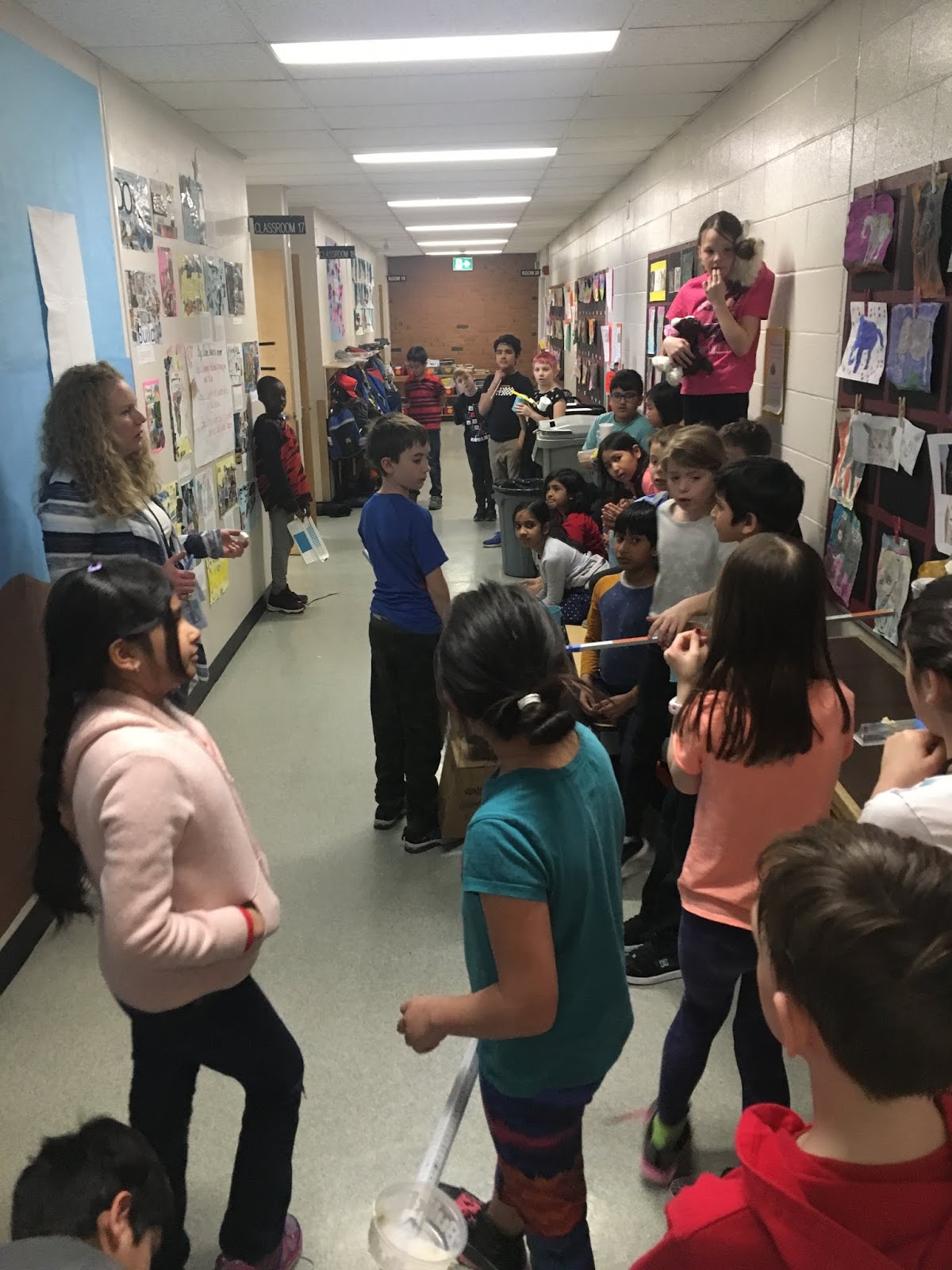
In science we continued building and designing simple machines, focusing this week on levers and a catapult challenge with the other grade 3-4 classes. Students worked individually or in groups and experimented with the length of load arms, resistance arms, fulcrum size, different materials (rubber bands, popsicle sticks, lego, meter sticks) to create a powerful catapult. 


We tested our designs in the hallway before we had our final competition in the gym. 


In social studies, we continued with our study of India, and learned about elephants. We then engaged in an art project, drawing and then painting elephants and decorating them as we discussed the festival of Holi, which occurred March 21st. Some of our students participated in Holi celebrations, and we were lucky enough to have them share some of their pictures and memories.


Have a fantastic break and see you all in April.

Thursday, March 14, 2019


Hello, again!

A very exciting and engaging week. We continued our design/blueprint-drawing/investigating/array-building examination of skyscrapers in math. We have some really nice drawings now, and several groups are beginning to transfer those drawings to our hallway wall. Below are some of those drawings, and some of the calculations and measurements the students made in order to create their scale drawings. It also allowed us to introduce new ideas and examine new ways of solving problems, such as division and long-division. 


In language arts, we finally have started to present our Rats of NIMH projects. Some unavoidable technological issues put this on the back burner for a while. Students showed their learning by creating slide shows on Google slides. They had to create a thesis and present evidence to back up their arguments. The groups did fantastic jobs on creating visually exciting presentations. They're also learning how to keep text to a minimum to ensure better engagement with their audience. 


In science, we continued with pulleys in our simple machines unit. After discussing some different configurations pulleys can take, such as block-and-tackle arrangements, we gave the students space to explore and build their pulley contraptions. Students really engaged with this hands-on activity, especially as we approached it like engineers and tried to come up with designs that could be useable (on a larger scale, of course). Below is a video of one such design. This student started with one fixed and one moveable pulley, but quickly realized he could alter his design to increase its efficiency. Another student was able to point out how this new design created a greater mechanical advantage, as her current understanding had it. It was so much fun to watch them talk about it. 


On Thursday, we had Teacher's Pet visit us for an in-class 'field trip'. Our presenter guided our students through building a specific type of electronic circuit, slowly adding pieces and having them build upon their previous work. After this, students played and explored through building, discovering different ways the circuits could work...or not work.


After working together to build similar circuits, each group was then given a challenge to build. Below is one team explaining their invention to solve a potential real-life problem. 


Friday, March 8, 2019

Hello again!

This week in math, we worked on our 'array city'. As mentioned, we decided to use real buildings and include them in our city. Each group researched and chose a skyscraper or tower and began the process of creating a scaled drawing of it. They had to figure out a scale that would work and that would allow them to produce an appropriately sized blueprint. We looked at real blueprints on-line and noted the size of the scale and the paper used by architects and designers. Using this information, the groups realized that reproducing a skyscraper on a single 8x11 sheet of grid paper would not allow for enough detail and would be difficult to work with. In the end, most groups decided on a scale of one grid line representing 5m. This meant that had to carefully tape multiple pieces of 8x11 grid paper together to create a large enough sheet to reproduce the building.


Strategies used by the groups to determine the proper scale included dividing the height of the building by 5 (the 5m scale they wanted) to determine the number of squares needed. Other groups chose 5m and then skip counted by 5s until they reached the height of the building. Other groups chose 10m increments and then realized their building would be too small, and then experimented with different increments.

None of the buildings chosen were perfectly divisible by 5s so the groups then had to decide on whether they would round up or down to the nearest five or if they wanted to further subdivide their grids.

The project is still on-going. Once the blueprints are complete, each group will then have to re-scale again to create our array city on our hallway wall. They'll also need to come together and decide on the scale we will use as a group in order to preserve the accuracy of our building relations on the wall.

Some groups decided that, because they're called blueprints, they should be blue. We may have to redo a couple of these :).


In this investigation, we have also delved into the science behind skyscrapers as part of our study of simple machines, and have hit many other grade 3 and 4 science curriculum outcomes, such as Building with a variety of Materials (we learned how experts do it: switching from stone to concrete, for example, as height increases and pressure grows). We looked at the innovations that made these giant buildings possible. For example, we looked at the elevator, its use of pulleys, and the invention of the safety elevator which allowed the first "skyscrapers" to be built. We discussed design-thinking and how architecture has to take so many different considerations into account (such as how to get people up to the top, thickness of walls and interior space, cost, and safety).

Our hallway wall will eventually be covered in blueprints, an array city of to-scale buildings, and our research about skyscrapers, such as how many people can work/live in them, how long to build, etc.

This has been a challenging task, and I'm very proud of how the students are engaging with it. We're probably a week or two away from this being completed, and I'll be sure to post more videos and photos as we go.

In science, we continued our work on wheels and axles and had our weekly contest with the other grade 3-4 classes. After looking at the principles behind wheels and axles, and investigating how changing the diameter of a wheel affects the distance travelled in relation to the axle size, many students chose to construct vehicles with larger wheels. Some did not. Below are some videos of our competition this morning.

Students also experimented with the slope of the inclined plane they wanted to use, the weights of their vehicles. They tried to limit the friction their wheels experienced.


We, of course, tested our cars in class. Here's a blooper of one of our tests :). 


Our class worked with our grade 1-2 buddies this week. We led our buddies in a math card game I've described in earlier blogs: make 10. Our students were very helpful showing their buddies different ways to make ten and helping further master their skills. 


In social, we are now safely in India. Mrs. Wilson gave our classes a bit of a scavenger hunt. Students were given a series of questions, and then had to research those on our school tablets and in atlases. They learned about the geography of India, including the oceans it borders, many of the regions and provinces, and cities. 


Overall, a fun and productive week!

Friday, March 1, 2019

Hello! We had a fun week, and it was nice to get outside again for recess.

In math, we started a new project that we've been talking about. We will be building an 'array city'. We decided on this as a way to decorate our hallway, engage in some art, and to use the opportunity to present some of our math learning.

Instead, however, of simply cutting out building shapes and posting them with arrays, we will be working with real buildings (Empire State building, etc) and scaling them down properly, before reproducing them on our hallway wall. We'll be looking at proportion, ratios, scaling, multiplication, division. We'll be thinking like architects, and deciding on proper scales for our blueprints. It should be fun and a challenge, and we'll be working on this for the next little while. Below is an example of a fairly simplistic array city. Ours should be quite interesting, and I'm excited to see what we can do.


In social studies, we are wrapping up our trip to Tunisia. Mrs. Wilson had the children create large-scale postcards that demonstrated what they learned about Tunisia. This authentic task allowed students to write and share in a way that they would actually do in their everyday lives. Students used the computers to help them research their ideas, as well as to find pictures that they could refer to for the picture side of their postcard. They also researched Tunisian stamps so they could have proper "mail" their postcard to family and friends.


In physical education, Mr. Ellice has us well into basketball. We have worked on dribbling with both hands, passing (both bounce and chest), and are now onto shooting.


Friday, February 22, 2019

In math, we are working on our multiplication skills. We're trying to build our number sense while mastering the algorithms. We played some math games with dice that challenged both the students' abilities to perform multiplication, as well as their understanding of numbers in general. Rolling dice, they were asked to arrange the numbers to create the greatest product possible. Many students at first arranged all the largest digits into one number and then multiplied that by a small number. For example, rolling a 6, 5, 2, and 1, many students made 65 x 12 instead of 62 x 51. It took them a bit to figure out how to make the largest product.

Students worked according to their abilities, with some simply performing addition with the dice, and others using 8 dice (4 digit x 4 digit). Other challenges included creating a multiplication problem that had regrouping in the tens column, or no regrouping at all, or the smallest product.

Next week, we'll continue with this, adding in word problems again. We'll also tie in some art by having the students create array art to help them practice thinking about and portraying multiplication visually. Here's an example of what that may look like, and I'll post some of our students' work next week.


We also did some dice math games with our grade 1-2 buddies. Our students helped our buddies master making 10 and 20 using dice.


In science, the students built small boats with sails and used rollers and wind power to move them. This was part of our simple machines unit. Next week, we'll discuss how rollers evolved into wheels and axles, and we will build a simple car. We are challenging the other 3-4 classes. This week, the challenge was to create the most efficient sail and roller system to move the boat as far as possible in 2 minutes. Our class came in second place in the Final Championship Game, moving their boat 192cm in 2 minutes. This hands-on task is very engaging, and the students are loving using their learning and applying it. Next week, we will take our cars and roll them down inclined planes to see whose car goes the farthest. Below are some photos and videos of what we did this week.


In social science, we are wrapping up our visit to Tunisia. We applied our learning to creating a postcard or short story about our trip. Students included what they had learned about Tunisian culture and history to write interesting prose.

In physical education, Mr. Ellice is introducing a new unit: basketball. The students are enjoying the challenge of hand-eye coordination in dribbling with both hands and moving at the same time.

Please note: for our science competition next week, students are welcome to bring in any wheels and axles they might have at home (lego, broken toys, etc.). We'll spend time next week learning about wheels and axles, and designing and building our cars. If you have any materials you could send in, that would be fantastic! Items could include:

-wheels and axles
-lego parts to build a car
-wooden dowel
-tongue depressors/popsicle sticks
-coroplast pieces
-skewers
-1 L milk cartons (clean and dry, please!)
-straws
-small cardboard boxes
-wire

Wednesday, February 13, 2019

A very short week, as teachers will be attending the Teacher's Convention Thursday and Friday. Despite that, we had a profitable, engaging week.

In math, we are well into multiplication now. The students have a good grasp of what it is. We are utilizing the simplified definition of 'repeated addition'. We have set out expectations for grade 3 and grade 4 outcomes (please feel free to view the Program of Studies: Math)and we are now building our competencies in the algorithms, starting with the standard. We'll examine the lattice next week. Students will be encouraged to choose and master at least one algorithm.

In literacy, we had our School-Wide Write this week. Students were given a set topic (If you could go anywhere, where would you go?) and a set time to plan, write, and edit. Given our short week, this took up most of our time.

In science, we are well into examining simple machines. We have looked at levers and inclined planes (the two basic types of simple machine), and will continue next week with the other four (wheels and axles, pulleys, wedges, and screws). We examined the concept of work, looking at it as the idea of force applied over distance. We talked about what is work, and what is not in physics.


With levers, we performed a small experiment that demonstrated how levers make work easier. By sliding the load along the meter stick (lever), students were able to physically feel the difference in the work their arm was doing to lift the load, as well as quantify that difference with a spring scale.


via GIPHY


via GIPHY


We also had our school science fair for the grade 5-6 students, and we had a chance to visit as a class and see what the other students were up to. 


In physical education, Mr. Ellice has worked hard with the students on various dance styles. Today the students had a chance to share their moves. 

On Tuesday, when we get back, there will be a geography test (postponed due to our School-Wide Write). It will be on North America. Students were given a study sheet earlier this week. In case they lost it, they need to know the following locations and be able to accurately place them on a map. This is part of our social studies exploration of Peru, India, Tunisia, and Ukraine. I believe we need to know, not just where those countries are, but their relationship to Canada, as well as know about our own continent. Students should be able to locate: 

a)    Calgary
b)    Ottawa
c)     Washington D.C.
d)    Mississippi River
e)    Rocky Mountains
f)     Pacific Ocean
g)    Atlantic Ocean
h)    Arctic Ocean
i)      Ellesmere Island
j)      Greenland


 Enjoy your long weekend, and we'll see you on Tuesday. 

Friday, February 8, 2019

Good day! Eventful, freezing cold week. With the weather, we had to resort to indoor recess all week. The kids did really well, considering. I think by today, though, cabin fever was starting to kick in. We did get outside briefly, early in the week. Our class went outside for a short spell to make snow.

Before we went, we made a hypothesis concerning cold versus hot water. There was general agreement that cold water, being that much closer to 0˚ C, would be more likely to turn to snow than hot water, which had to cool down to zero before it could turn to snow. After our hypothesis was made, we ventured into the -28˚ wasteland. Everyone was quite surprised by the results. So, after we got back inside we went online and investigated why exactly hot water and not cold water turned into snow. Given our just-ended minerals unit, the crystallization of water fit nicely.

Enjoy our videos:

COLD WATER


HOT WATER


In math, we are now into multiplication and division. We will keep tying in what we're already studied, of course. Too often a unit is done and then we move on. Not a good strategy with anything, but especially math. So, our math will progressively get more involved, tying together all we've been doing. At home, you can help your student with the math games and number sense activities which I've posted in the past, as well as continuing to help them master their chosen algorithm for addition, subtraction, and multiplication.

In literacy, we've been continuing our ongoing Field Guide project, adding camels now that we are in Tunisia. We will also start doing some more creative writing this week. I'd like to start some poetry, using similes and metaphors to describe winter. An apt time, given our current weather. Here's an example of what I'm hoping for from a previous student. I think it's quite beautiful, and I'm excited to see what we can do this year.

The Northern Lights

The northern lights
Are a blanket covering
The earth. It keeps me
Warm when it's cold, fading like
Snow when it melts, the shadow like sunlight
on a warm day, colourful like beautiful flowers
moving with the wind.

In Science, we had a bit of a gong show with our last test. The students were prepared, but our technology wasn't (we were trying to use Google forms). We'll work on this, and we'll have this assessment done as soon as we can. Assessment is, obviously, important; but pushing it just to get it done isn't a good idea. I want to know what they know, not if they're able to fight through glitches.

We have moved on to our next topic: simple machines. We've introduced the topic, started a bit of work, and discussed our main project. We'll be working in groups to build our own Rube Goldberg machines. We watched the video below to give them an idea of what it could be like, and to inspire them. We'll discuss the parameters, expectations, and build our rubric, and then get building, with mini-lessons about each machine as we go. This should be a great unit! Expect lots of videos....unless I forget! Oh, yes: we'll need lots of materials, so please help your student bring anything they feel they could use for their machine.