Thursday, May 16, 2019

In math, we've moved on to perimeter, area, units and measuring. We'll be engaging in a number of activities that will involve learning about these ideas with hands-on measuring. We began today with measuring our classroom. Students worked in different teams and attempted to measure the perimeter of our classroom. After they had finished measuring, I asked the teams to compare their measurements. They were astounded at how different they were, some off by more than 1 or 2m. We talked about why that was, and the importance of measuring accurately and how to do that.

We'll redo this activity next week and use our (accurate) measurements to create a scale drawing of our classroom, including the perimeter and area in sq. m. We'll have to decide on the proper units to use and how to scale our blueprint, as well. We'll discuss converting to different units (cm, m, mm, km, etc.).


We also had a visit this week from It's a Crime Not to Read. Calgary police officers visited and read to the students. If your child has any books from ICNTR, please have them return them to school on Tuesday. 


In social, we worked on designing Pysanky eggs, a Ukrainian tradition. On Wednesday, May 22 our class will use our designs to create their own eggs. As we'll be using dyes to color our eggs, please ensure your child comes to school prepared for this activity by supplying them with clothing they do not mind staining. These dyes will NOT come out of clothing. 


In literacy, we are working developing characters, plots, and settings towards a new short story writing project. We're looking at how professionals do it. Using my experience as an author, editor, and academic, we're examining the process of creating interesting writing, editing, and publishing. 

On May 30th our school will be going on a school-wide picnic to Bowness Park (weather permitting). We'll be bussing to a nearby school and then walking to the park. We are looking for volunteers, so if you have your up-to-date police check and are on our volunteer list, we'd love to have you help out. 

Have a great long weekend. Remember, no school Friday or Monday!


Friday, May 10, 2019

Hello.

In math we've split up a bit more than usual with 3s and 4s. Our 4s are now working on decimals, which is not part of the grade 3 Program of Studies. So, our threes have been working on developing their understanding of what fractions are, and have been relating fractions with similar denominators to each other (ordering 1/5, 3/5, 4/5, 2/5, etc.) using visual and manipulative strategies, as well as developing their mental math strategies.

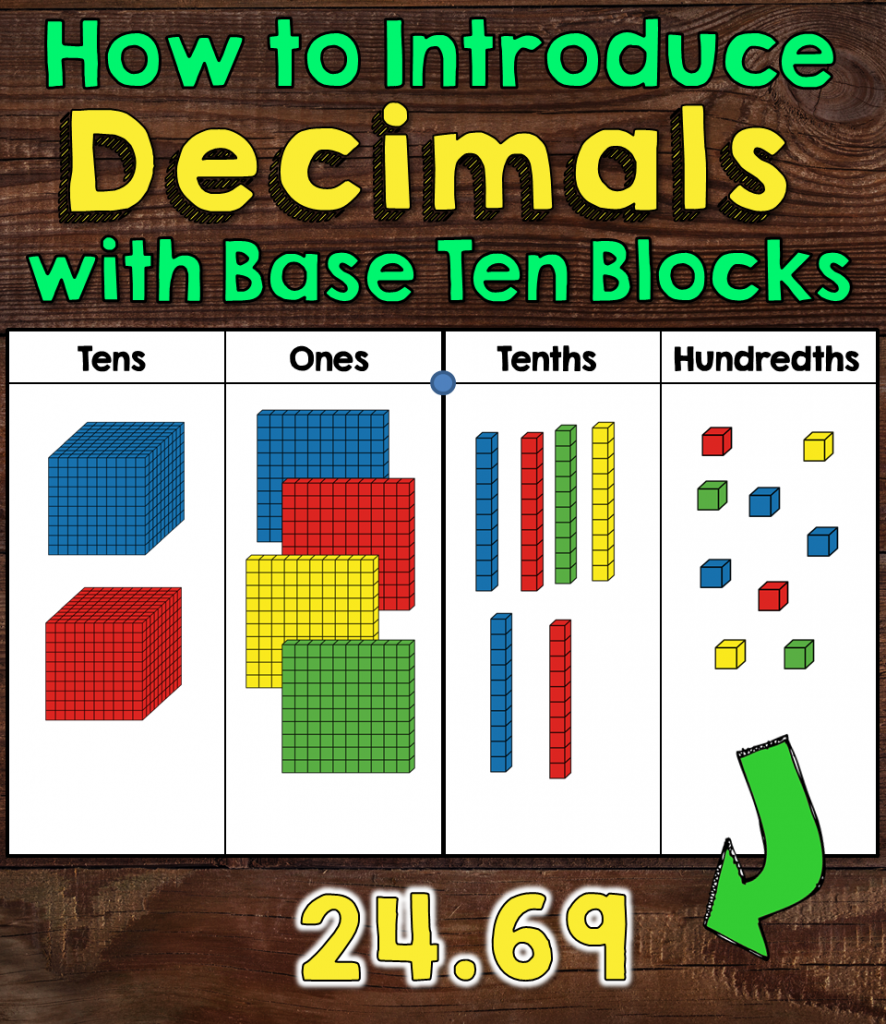
Our 4s have been working on decimals, relating them to fractions, understanding place value to the right of the decimal point, as well as adding and subtracting numbers with decimals.


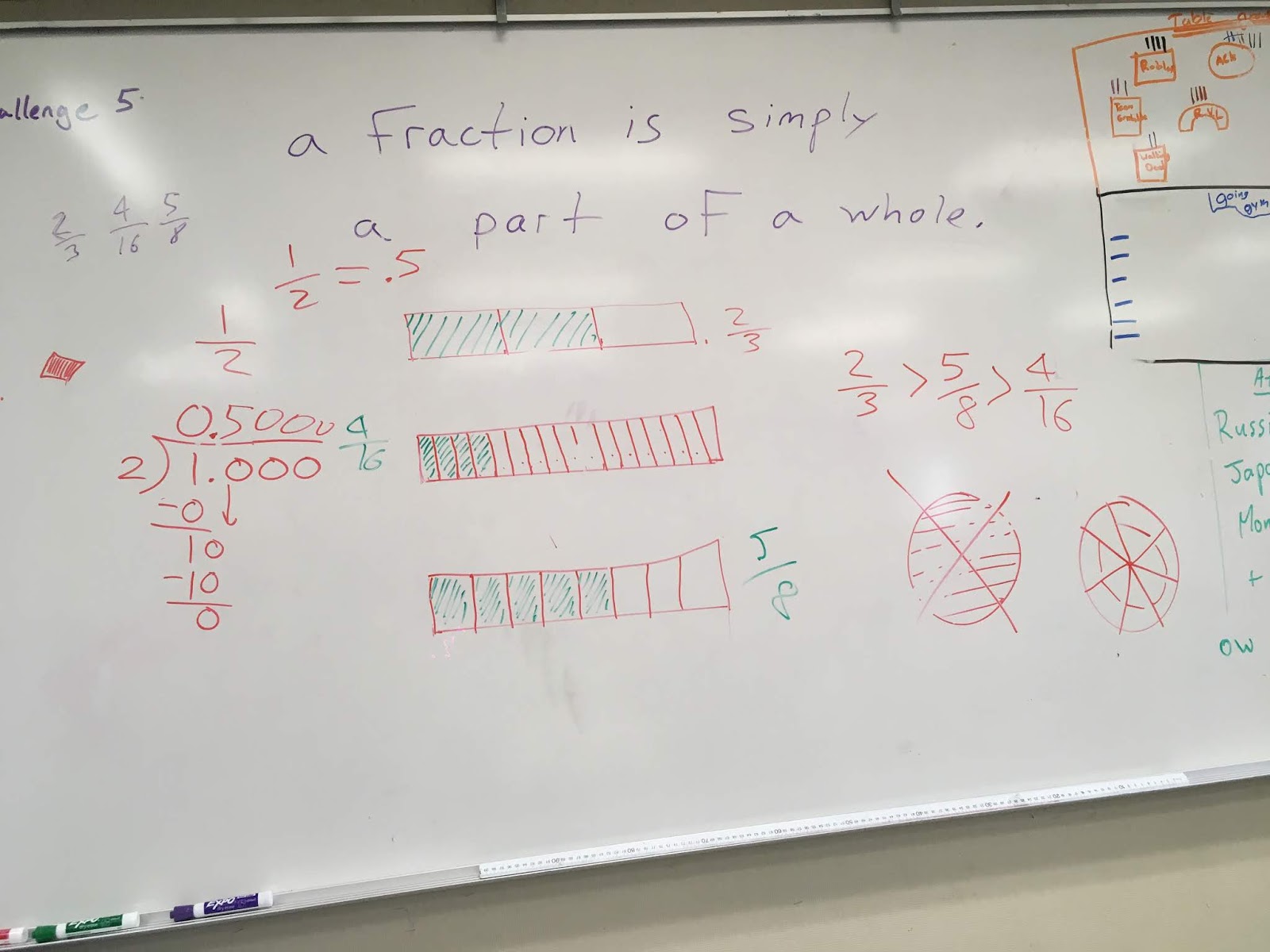
A few of our 4s wanted to push their limits, and have also been working on converting random fractions to decimals using division, representing that decimal as a new fraction (x/10, x/100, etc.), and then reducing it back to the original fraction they started with (see below).

For those students I gave a further of challenge of trying to do it with 1/3, and then we examined why it didn't really work very well (1/3 = .333333...) which led to a discussion of base-10, base-12 and some other ideas we discussed over the year).


If your student is struggling with the concept of place value with decimals, you can try using manipulatives (shown above) to help them visualize it. Here is a link to one way of doing it: decimals with base-10 blocks If you don't have these blocks (you probably don't!) you could use other objects such as lego. 

In science we are wrapping up our Rube Goldberg machines. We've had many challenges as well as successes in creating these. We'll have a bit of review on the Simple Machines unit and then a summative assessment (unit test) before we move on to some more plants and animals. Our room is a disaster area of cardboard, paper, and other items, so we'll all be glad to get this finished and cleaned up :).


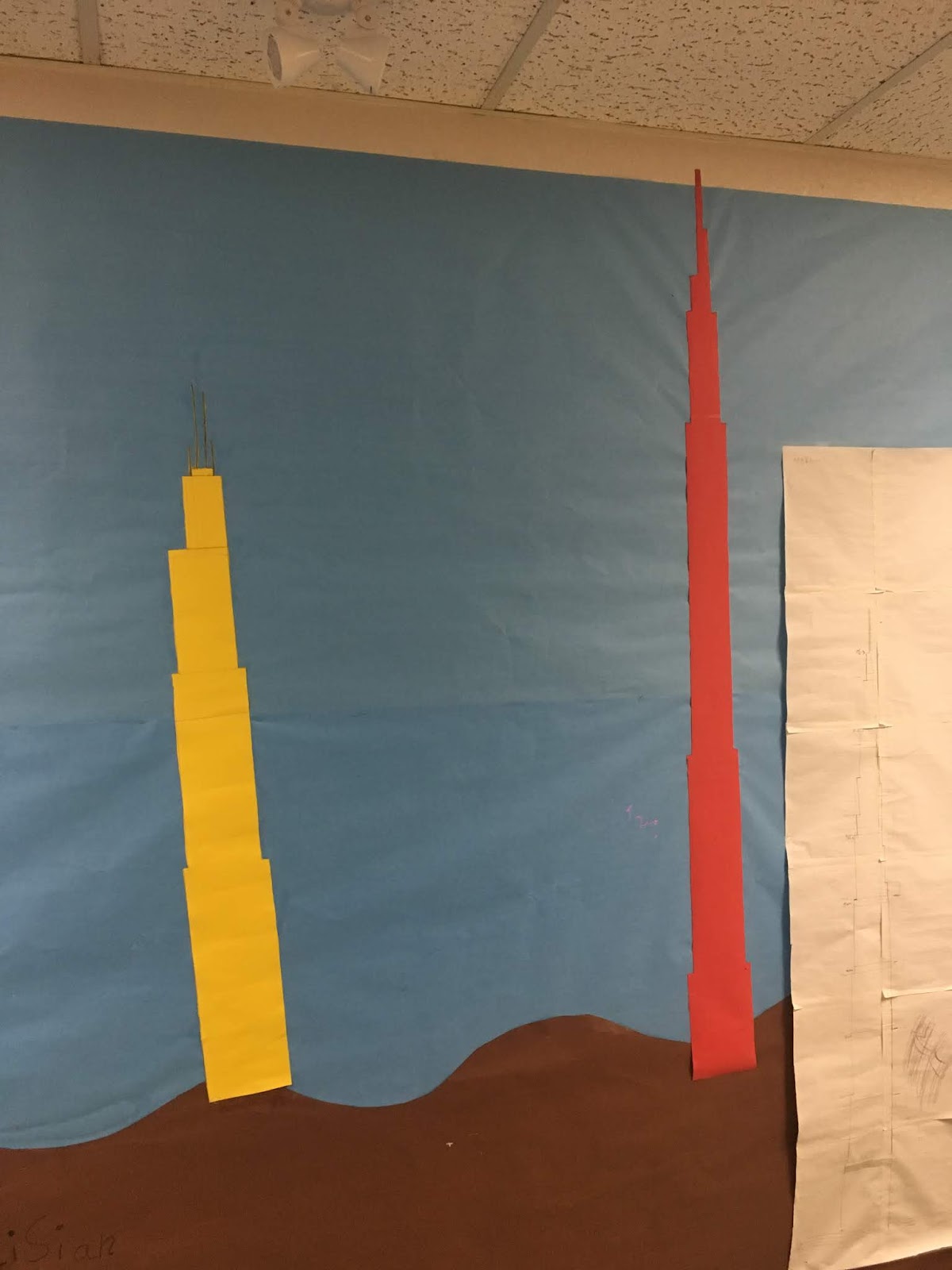
You can see above some of our towers from our tower project. Next, as we move into collecting and graphing data in math, we'll create different graphs based around our towers (height, # of elevators, # of people they hold, etc.) to continue to tie in our math with our science.

In literacy, our grade threes have been working hard on mastering basic grammatical terms and concepts. Ask them about parsing sentences. We've been working on naming all the parts of our sentences, from prepositions and prepositional phrases, to subject, verb, noun, adjective, etc. These basic skills are foundational for good wri...sorry, I mean well writing ;).

We are also working on developing characters, plots, and settings as we work on creative writing. We also did some persuasive writing, with students selecting a superpower they would like to have and then arguing why they think it's the best one to have (on-going).

In social, we are in Ukraine now with Mrs. Wilson and are exploring the country through videos, images, and books.

Friday, May 3, 2019

Hello.

In math we are wrapping up fractions. Some students, however, still find the concept of fractions very complicated, so please continue to work with your child on noticing how fractions are used in everyday life and help get them used to them.

In our weekly Mrs. Wickland challenge, students worked on the following problem.


Several of our students, who had completed their other projects and had some time during our Catch-Up period, wanted to expand the challenge. They had been interested in the mosaics we had studied during our Tunisia unit and decided to create their own mosaic, as well as calculate its value given a triangle = 1. See some of their work below.


They then went even further! They're not quite finished yet, but through discussions with them, they have a solid plan to calculate all these shapes. We'll see if they can do it accurately! The rest of our students worked on the original project, so please ask them how they solved it. 


In social studies, Mrs. Wilson had us all fly to Ukraine to begin our final country investigation. Students had their passports stamped and approved, and we landed in Kiev. We'll finish our journey here, learning about the flora, fauna, people and cultures, geography and climate of Ukraine. 

In science, students are ironing out their blueprints, and some groups have started building their machines. We'll have a busy and messy week upcoming as our machines start to take shape. Ask your students about their part in the building process, as each student must work on a specific part of the machine themselves to ensure all the group participates. Is your student working on the wheel/axle? Maybe a lever? If so, do they know what class of lever? 

Relatedly, we'll be having a science unit test soon on our Simple Machines unit. We'll create the test together to ensure we're all in agreement about what learning intentions are fair to examine and how best to show our learning. A study guide will be created collectively, and students will be given ample time to prepare. More on this as it gets closer. 

Friday, April 26, 2019

Hello. Wow, only 2 months left! So much left to do!


Our weekly math challenge from Mrs. Wickland is below. Ask your child how they solved it!


In math, we are now on fractions. We started with a very simple definition: a part of a whole. We are looking at the idea of similar fractions (1/4, for example) representing different amounts. In other words, the idea that 1/4 of a chocolate bar is a different amount than 1/4 of a whale.

We talked about how each part is the same size in fractions (when you divide something into 4 equal parts, those parts are equal or the same size), and we looked at ways to compare different fractions, such as by visualizing them either in drawings or with manipulatives, working both with common denominators and looking at how we could compare fractions with different denominators using drawings.

Related image

Fractions are pretty tricky for many children. You can work with your child by showing them, and asking them, about fractions in everyday life. One obvious example could be money. Why is a quarter called a quarter? Talk about pizza, pies. Show them measuring cups for baking. Show them how we use fractions all the time, as well as in estimating (have them estimate half a slice of bread, a quarter glass of milk, etc.)


In literacy, we finished up and handed in our poems about Spring, using metaphors and similes. I'll have these marked this weekend and returned to students on Monday. Students made some very good comparisons, and demonstrated their understanding of what similes and metaphors are and how to use them properly.


In science, we are taking our learning about simple machines and applying it to a large project: building a Rube Goldberg machine. Students chose teams to work with, approved their teams with me, and then began working on their designs.

Image result for rube goldberg machines originals

Image result for rube goldberg machines originals

The project has several parts. First, students must complete a detailed blueprint of their project and have it approved by me. Their blueprint should be neat, labelled clearly, as much to scale as possible, and show the purpose of their machine (feed a treat to a pet, fill a cup with water, help someone sick or injured reach something needed). Once their blueprint is ready, they then need to create a Materials Checklist and use what is on that checklist.

We are treating this like real scientists and engineers, planning, revising, testing, and putting in some hard work. Below are some of the preliminary efforts at creating the blueprints. Once completed, we'll hang these machines on the classroom or hallway walls, or even possibly put them in our Learning Commons for all students to examine and interact with.

Help your child find some useful materials to help them make their machine. Ask them what they are trying to build and what its purpose is. Watch some videos with them on Youtube (there are a lot of them!)


In music, students who ordered them received their recorders today from Mr. Avery. Enjoy! :)

In Phys. Ed., the weather has allowed us back outside, so Mr. Ellice has been having us do a lot of running and playing on the soccer fields.

Friday, April 19, 2019

Hello again.

A short week this week.

We continue to work on our tower project, multiplication, and division. On Monday we'll be starting fractions and decimals.


In science we worked on building a car that used potential energy to move. Students used elastic bands, balloons, and other materials to move their vehicle.

Our challenge with the other grade 3/4 classes using these vehicles to move at least 2m will occur Monday. If your child did not bring any materials to build their vehicle, try to work with them this weekend to build one. They must do the work, however, and re-build their creation at school to demonstrate their understanding of what they did. I sent a handout home earlier this week. So far, we have about 3 or 4 cars.


In literacy, we started a poetry unit, focusing on using simile, metaphor, and other literary devices to write a poem about spring. We discussed what made a simile or metaphor a good one, examined some bad ones, and will now write our own.

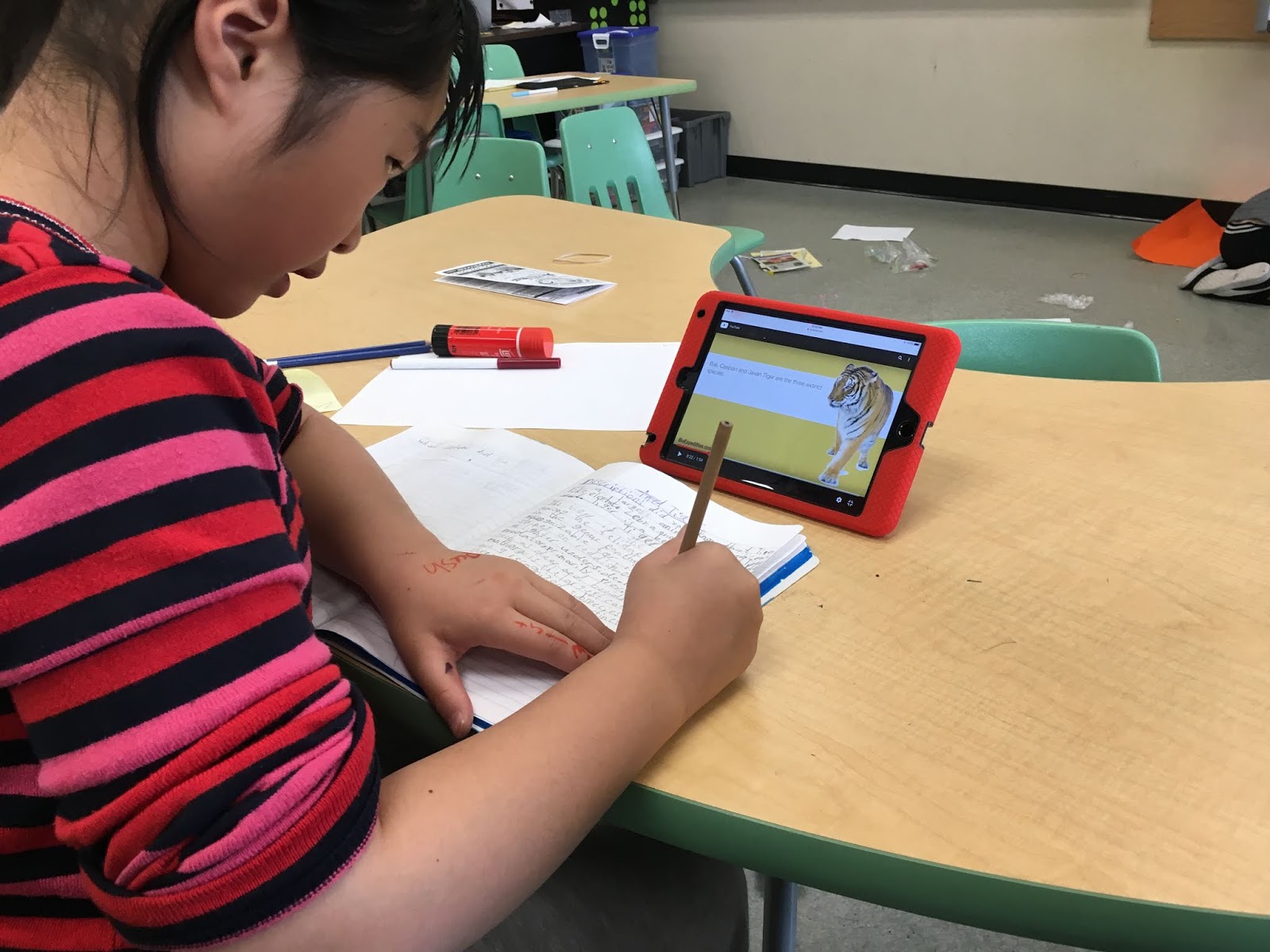
We also continued to work on researching and writing about tigers and elephants for our Field Guide.


Friday, April 12, 2019

Great week...until that snow fall (what's with that??).

In math, we continue many different projects. We continue to work on our facts and skills with algorithms, but we also continue to work on more authentic tasks, such as our tower building. As we work on these, I'm reminded of the saying 'everything takes longer than it takes'! We are slowly getting there. It's been a challenge, but a great learning opportunity. One student yelled out loud today and jumped up and down when she finally figured out a key problem to getting her tower to the right scale. She was so proud of herself, as I was of her. Here's some of what we've been getting done:


We also worked on Mrs. Wickland's latest math challenge (you can find these on our school website or her blog). 


In our writing, we continued work on our Field Guide, working on our tiger or elephant entries. 


Also in social studies, we started a small art project centered on henna, the body art tradition popular in India. Students traced their hands in their visual journals and then used examples to create their own henna designs. 


As symmetry is an important element of some henna designs, we also learned more about symmetry and how to try and create it. One student remembered there is a mirror and kaleidoscope function in our classroom iPad cameras and he used it to demonstrate symmetry to his peers. 


Friday, April 5, 2019

Hello again.

In math, we had a quiz as a snapshot and check-in for where we are with some of our basic facts. I will hand them back on Monday. This type of testing is only one form of assessment, and I encourage the kids not to get stressed out about them.

We continued to explore multiplication and division. We worked on building our number sense by examining a multiplication problem and then trying to express it in different forms. We watched the following video as a model, discussed it and analyzed what was happening and then tackled the problem offered at the end of the video. I encourage you all to watch it. The students struggled to grasp some of what was going on, suggesting we are still building that number sense that is so important for an understanding of mathematics. I think too many confuse arithmetic (in the sense of being able to perform algorithms for addition, subtraction, etc.) with mathematics. Some students, though very proficient with the various algorithms, struggled to comprehend what was going on in the video. So, we will continue with activities that help to build number sense.


Here are some examples of the students' work on the problem in the video of showing 12 x 9 in different ways. 


We also continue (slowly!) our array city project. Students are now converting their blueprints into another scale to fit our hallway wall. Several students figured out that long division could help them as they tried to figure out how to show that 1cm = 5m in our new scale. They realized that they could divide the height of their building by 5 (m) and that the quotient would correspond to the height in cm, and so a 200m section of the Willis Tower in Chicago would become 40cm on the hallway wall. They also had to deal with remainders in some cases and decide what to do with them: round up or down, or stay exact.


In social studies, we are in India still. This week we tied our study of this country with our ongoing examination of plant and animal life cycles and our writing project of creating a Field Guide for the animals in the countries we've studied. To our toco toucan, Andean condor, Peruvian lily, and Tunisian camel we added an Indian element. Students chose either the Indian elephant or the Bengal tiger and researched it. They had to take that information and organize it into one of three sections, description, life-cycle, or adaptations. This is a good exercise to get students thinking critically about what they are reading, tests their comprehension, teaches them new vocabulary, and helps them become better writers as they take those facts and put them into their own words in an interesting way.


In phys. ed., Mr. Ellice began our hockey unit. It was awesome watching the students play and the teamwork as they passed and assisted each other. There were two lines for each team, and it was great to see them shift without complaining, as well as cheering each other on. 

See you next week!